Résumer cet article avec :
 ChatGPT
 Mistral
 Claude
 Perplexity
 Grok
Grok
You have purchased a magnificent new shirt … You are probably wondering how to maintain it and especially how to iron it? Stop using a very hot iron! Fortunately for you, we know about how to cold iron ! This technique is perfect for delicate clothes. Here are our tips for mastering cold ironing.

What is cold ironing?
Ever wondered how celebs keep their designer outfits looking fab without damaging delicate fabrics? Well, cold ironing is their (not so) secret weapon! This gentle technique uses lower temperatures (below 110°C) to smooth out wrinkles while protecting sensitive materials. We know what you’re thinking – can an iron really work when it’s not super hot? Trust us, it’s a game-changer for your favourite delicate pieces, and we’ll show you exactly how to master this wardrobe-saving skill.
As you know, ironing is a household task which, like the others, requires practice and above all good ironing techniques ! For this, you must know how to read and understand the symbols of clothing labels :
- The symbol of the basin containing water: indicates the washing technique (by hand or in the washing machine)
- The triangle symbol: the chlorination technique to use (for bleaching)
- The square: how to dry the garment (dryer allowed or not)
- The round: the technique to use if the garment must be washed by a professional (dry cleaning)
- The iron: indicates whether ironing is tolerated
Regarding ironing, you will notice that the iron can contain 1, 2 or 3 points. This is precisely what interests us! These points indicate the nature of the textile and therefore the ironing method to adopt.
The meaning of the dots on the iron symbol:
- One point: cold ironing required (at 110 ° C) for acrylic, nylon, silk or acetate fabrics
- Two points: hot ironing (at 150 ° C maximum) for polyester or wool
- Three points: very hot ironing (200 ° C) for cotton or linen
This is precisely what “cold ironing” is. Remember, only one point! You should then set your iron to this temperature.
How to Cold Iron Different types of Clothing: Step-by-Step Guide
Feeling overwhelmed by that pile of wrinkled clothes? Don’t worry, we’ve got your back! Here’s your step-by-step guide to getting those creases out like a pro.
Delicate Fabrics (Using Cool Iron Temperatures below 110 ° C)
Silk and Satin
- Use a pressing cloth
- Iron while slightly damp
- Keep the iron moving constantly
- Turn inside out
Nylon and Synthetics
- Use lowest heat setting
- Press gently
- Iron on reverse side
- No steam needed
How to cold iron Polyester
- Iron while slightly damp
- Use medium heat
- Press on reverse side
- Watch for shine marks
Make sure to carefully fold your clothes to avoid creases.
Can You Steam Cool Iron Your Clothes?
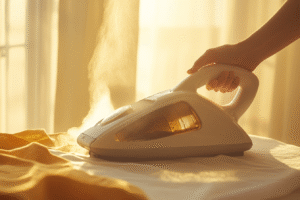
Are there other methods for cold ironing textile fibres? Well, yeah ! Most clothes steamers use hot steam around 100 ° C.
You can therefore use a steamer to remove the creases from your acrylic shirt …
Also note that the wrinkles that appear on your clothes after washing are due to the fact that there is a lot of laundry in the drum of the machine! Doing a wash with less clothes in your washing machine will allow you to have less wrinkles!
Frequently asked question
Can a cold iron spray work for wrinkles?
Yes! Cold iron sprays can be your wrinkle-fighting bestie for quick touch-ups. While they won’t work miracles like a traditional iron (sorry!), they’re brilliant for smoothing out light wrinkles, especially on natural fabrics. Just remember to spray lightly, smooth the fabric, and let it dry completely — easy peasy!
For expert ironing services, don’t hesitate to call a Wecasa professional house cleaner who can ensure your clothes are perfectly pressed and crease-free. There are many reasons why booking a professional ironing service is best.